WIFI development board based on ESP-8266EX with Arduino compatibility, 11 digital I/O pins, 1 analogue ADC pin for 0-3.3V input, OTA wireless upload capability, and onboard 5V 1A switching power supply accepting up to 24V input
ESP-8266EX WIFI Development Board for Arduino Programming with OTA Upload
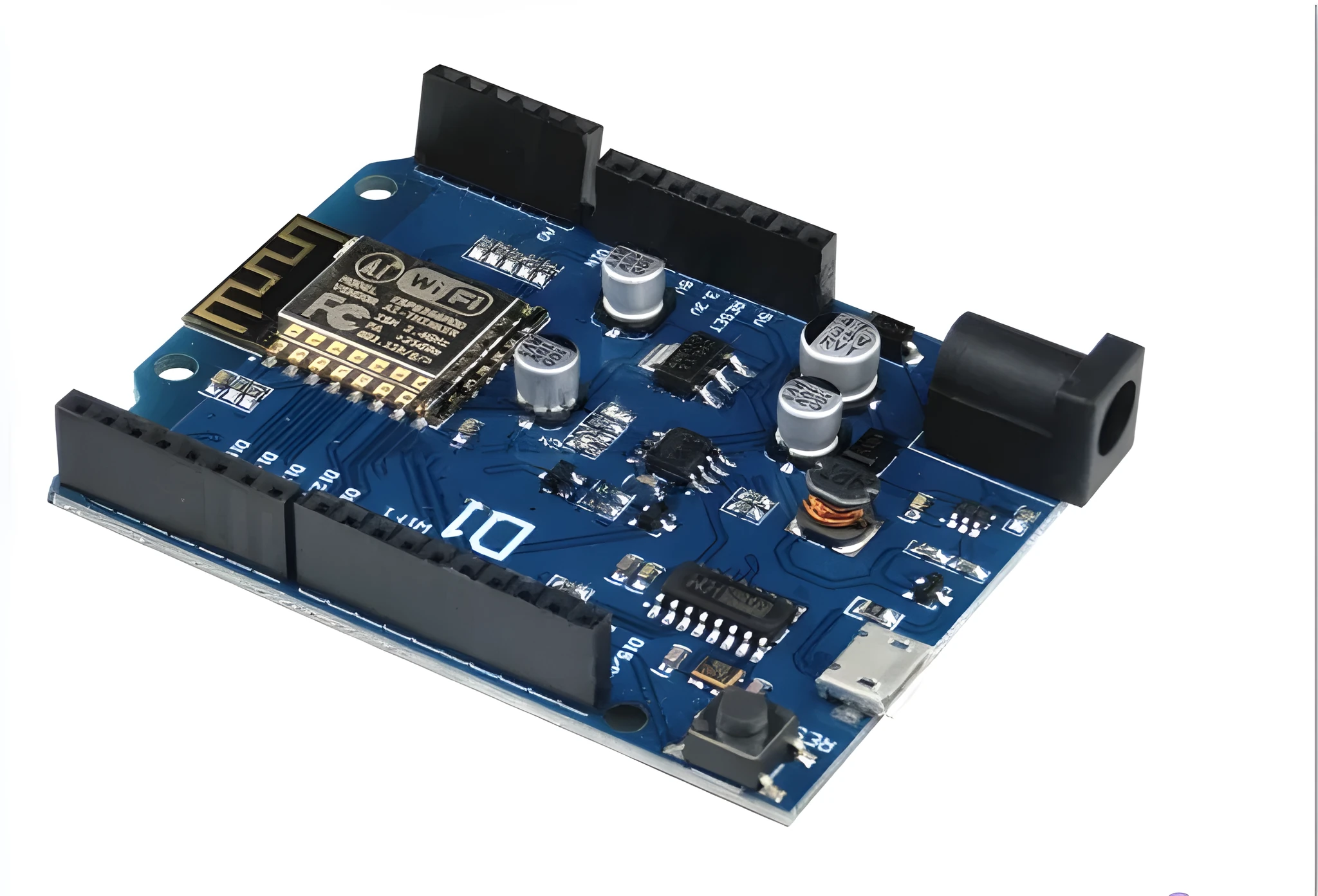
This development board is built on the ESP-8266EX chip, offering a practical entry point for creating connected projects. It is designed for direct compatibility with the popular Arduino IDE (Integrated Development Environment), allowing you to program it using familiar methods and a vast library of existing code. A significant feature is the inclusion of OTA (Over-The-Air) wireless upload capability, which lets you update your device's firmware without a physical USB cable connection after initial setup. The board also simplifies your hardware setup with an integrated 5-volt, 1-amp switching power supply, which can accept a broad input voltage range.
Features and Construction

The board's functionality is centred on providing the essential tools for IoT (Internet of Things) and embedded system prototyping. It combines the processing and wireless capabilities of the ESP-8266EX with a user-friendly development interface.
Material and Build
The primary stated material is the ESP-8266EX module, which forms the core of the board. This module is known for integrating a Tensilica L106 32-bit microprocessor, WIFI transceiver, and memory. The board's construction incorporates this module alongside the necessary supporting circuitry, including the switching power supply component that regulates higher input voltages down to a stable 5V for the board's operation. The design ensures compatibility with the Arduino ecosystem.
Size and Practical Fit
While exact physical dimensions are not provided in the source material, the board's layout is designed to accommodate 11 general-purpose I/O pins and one dedicated ADC pin. This configuration suggests a form factor suitable for prototyping on a breadboard or mounting in an enclosure. The inclusion of an onboard power supply reduces the need for external power regulation components in many projects, making the overall build more compact and streamlined.
Uses and Placement
The board is intended for a wide array of electronics projects that benefit from network connectivity. Its specification-supported features make it suitable for both learning environments and functional prototype development.
Event or Professional Use
In professional or educational workshop settings, this board can be used for rapid prototyping of smart home sensors, wireless data loggers, or simple IoT devices. The Arduino compatibility and OTA support are advantageous for iterating on designs quickly, as changes can be deployed wirelessly to multiple units. The ability to handle input voltages up to 24V for its onboard regulator also allows it to be integrated into systems using common power adapters or battery packs without an additional regulator.
Everyday Home Use
For hobbyists and makers, this board enables the creation of custom WIFI-connected gadgets for the home, such as temperature monitors, smart lighting controllers, or notification systems. The 11 I/O pins provide enough connections for sensors (like temperature or motion) and actuators (like relays or LEDs), while the single ADC pin is specifically for reading variable analogue signals, such as from a potentiometer or certain light sensors. Programming it like an Arduino UNO lowers the learning barrier.
Benefits and Buying Value
The board's value lies in combining several key features into a single, ready-to-use unit, reducing the complexity typically associated with adding WIFI to a project.
Reuse and Low Maintenance
The OTA wireless upload feature directly supports reuse and low maintenance. Once a device is installed in its final location, you can push firmware updates or bug fixes without physical access to the board, which is ideal for devices mounted in hard-to-reach places. The robust power supply design, accepting inputs up to 24V, also means the board can be repurposed for different projects with varying power sources without modification.
Why Choose This Product
This board is a practical choice because it consolidates the ESP-8266EX's power with user-friendly Arduino development and built-in power management. It removes the need to source and connect a separate WIFI module, a separate voltage regulator, and implement OTA code from scratch. For developers familiar with Arduino, the transition to this WIFI-enabled board is straightforward, allowing you to focus on the application logic of your project rather than complex driver-level integration.